
about
For the past eighteen years much of my professional time consists of helping students explore academic disciplines. Recently I began reflecting on my own understanding of academic disciplines and careers. How do students choose their studies and their potential professions? Where does their knowledge of work and disciplines derive? What role do I play in their exploration and understanding of work?
In the beginning of my career, I believed students were coming to me with labor “myths” – preconceived, culturally constructed, notions about work, and I, in my “great knowledge” would reveal the truth to them: the correct choice of career/major is fulfilling your passion. Their “mythical” understanding of careers means they know about health care, engineering, technology, and law as a preconceived image although they are not clear on the actual work, nor the skills and knowledge necessary. The academic disciplines of many professions is indeed, ambiguous. While I affirm certain professions require specific, disciplined education: engineering, accounting, trades, health care, STEM, etc., I use countless examples to demonstrate to students – the world of business, nonprofit, civil service, and seemingly the majority of careers do not care about your program of study. Those professions want a degree (or so the myth goes), and you may safely choose your passion and find your purpose: to seek happiness at work. I even created a university course called Create Your Story where students would write about their values, interests and skills, in the hopes to discover and work toward a career of passion and purpose.
In this space, I want to trace the cosmology of work – the myth of our current labor identities because it forms and shapes our reality in our finite moment in time. Our cultural cosmos begins with a question: “what do you want to be when you grow up?” In my own work with students exploring majors and professions, I am not sure how I could help them outside the myth of workplace happiness and a “purpose driven life?” Is it possible? Both Mark Twain and Confucius are attributed of expressing: “Find a job you enjoy doing, and you will never have to work a day in your life.”
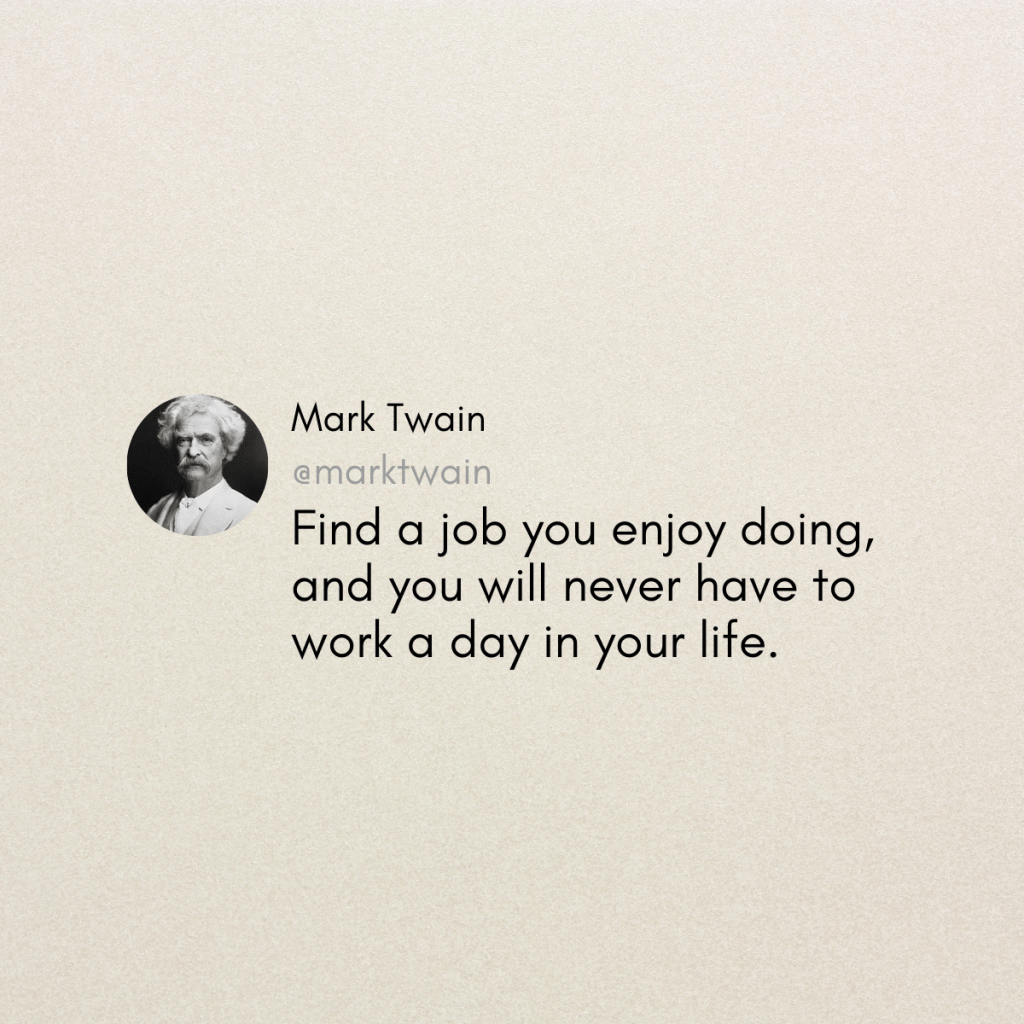
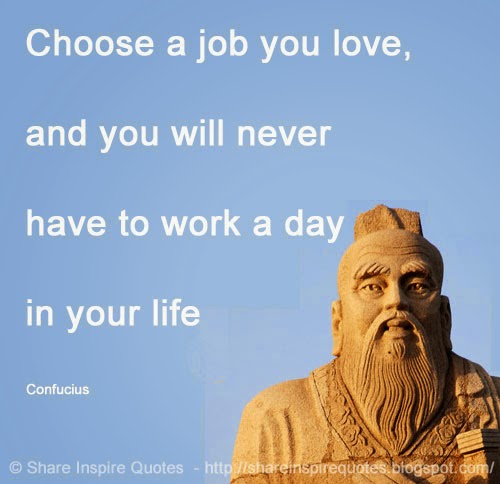
While neither Twain, nor Confucius actually made the statement, their memes circulate the internet in fancy images – a myth of purposeful work and happiness.
I am beginning here with an exploration of labor identity, as well as examining data about labor and stories about professional identities, capital, and time. The reason to labor, to work, toil, grind, culturally survive is in our existence: work is necessary. How we perceive work is ecologically and culturally grounded in narrative – in the stories, and often cultural myths, we circulate about work and identity.
My own professional positionality is a form of bias, as is my time and work experience, and this entire exercise will inevitably generalize (this is my disclaimer). All seen and written here is an exploration driven by curiosity from my own work. While labor can be viewed from many different aspects and include all types of work, much of the data, media, and research here is focused on professional work. I own that my own professional position is privileged for a variety of reasons, so when I insert myself here, I acknowledge not experiencing or understanding the breadth and depth of global labor, identities, nor all lived experiences in all work settings. Lastly, I’m not seeking a “Truth.” I’m exploring how cultural myths shapes us and impact our choices. I am asking “why,” exploring “how,” and contemplating the influence of cultural narratives. Also, to love one’s job, to find purpose in what you do, or to feel satisfied are lived experiences too. This space is about reinforcing, not negating, lived experience while exploring a cultural cosmic myth: labor identity.
~ amber paulson, 2025
 Imagine Sisyphus Happy